The Golden Rule: Talk to an Expert First
If you think you need a water well, your first instinct might be to jump onto Google and start researching. While I always encourage homeowners to be informed, I strongly suggest reaching out to a local professional before you dive down the internet rabbit hole.
Here is why: geology changes drastically across the globe. In fact, a single region can have multiple different geological makeups. Because geology is the single most important factor in constructing a well, local context is everything. Without it, you might base your decisions on internet advice that is completely inappropriate for your area.
By speaking to a regional expert first, you build a solid foundation of local knowledge. Then you can do your own research, and you will be much better equipped to understand the data and make informed choices.
What Happens When You Call a Professional?
When you call a reputable well contractor, they shouldn’t just give you a random price over the phone. A true professional will take your exact location and do some background research.
At our company in Northern Ontario, we look up your location in the official Ontario Well Database, cross-reference it with our own historical company database, and—if you are in a high-risk area—we will even consult our drillers and competitors. We want to gather as much data as possible so you can make an informed decision.
During that first call, an expert will also ask why you want a well. A new well isn’t always the right solution to every water problem. Depending on your situation, a professional might actually talk you out of drilling and suggest an alternative, such as:
- Repairing your existing well.
- Filtering your current low-quality water.
- Installing a cistern: A large holding tank that stores water, which can drastically increase your home’s usable water capacity without needing a new source.
The Hard Truth: There Are No Guarantees
In some parts of the world, the geology is perfectly uniform for hundreds of miles. In those areas, a contractor can quote a price over the phone and practically guarantee success.
Northern Ontario is not one of those places. Our geology varies wildly, which brings us to the hardest part of drilling a well: there are absolutely no guarantees. We tell this to our clients emphatically and repeatedly. While we usually know what the average well in your area looks like, we never truly know how deep your specific well will have to go, or what the water quality and quantity will be until we start digging.
A Real-World Example: We once worked on a subdivision where historical data suggested the average well depth would be about 100 feet. The developer decided to drill every other lot first, leaving the spaces in between for later.
The first three wells all went nearly 300 feet deep. The client hadn’t budgeted for this and had to scramble to secure extra bank funding. He decided to push forward, and the next three in-between wells were all only 60 feet deep! Our entire staff was shocked. It perfectly proved a fundamental truth: your well can completely defy the local average.
Drilled vs. Dug Wells
During the estimating stage, your contractor should discuss whether a drilled or dug well is best for your property. While there are various ways to construct a well globally, these are the two primary methods:
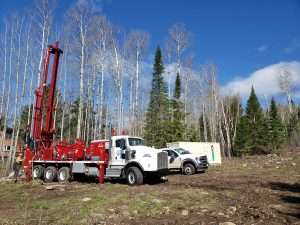
- Drilled Wells (90% of our region): Created using a drilling rig that bores deep into the earth or bedrock. These are generally preferred because they access deeper, more secure water sources.
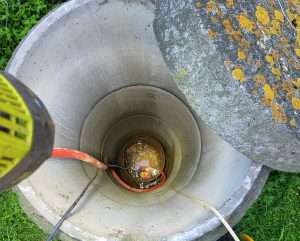
- Dug Wells (About 10% of our region): Created using an excavator to dig a wider, shallower hole, which is then lined with concrete tile.
While drilled wells are usually the better choice, a dug well might be recommended based on your specific property layout or unique local geology.
Siting the Well (and the Truth About “Water Witching”)
Once you approve an estimate, the next step is siting the well. This is an engineering term for choosing the physical location of your well based on property restrictions, topography, and mandatory safety clearance distances from potential contamination sources, including:
- Roadways and driveways
- Fuel storage tanks
- Septic fields and privy pits (outbuidings/outhouses)
This brings up a sensitive but highly popular topic: Witching a well (also known as dowsing).
Witching is the practice of using two L-shaped wires, rods, or a Y-shaped live willow branch to locate water through what some describe as divine, spiritual, or unexplainable natural forces.
To be completely fair and transparent: we do not recommend witching. In the thousands of wells our team has constructed, we have tracked the success rates of “witched” locations versus locations chosen purely via engineering and topography. Statistically, there is zero difference in success. Furthermore, we have never met a witcher who accurately predicted the correct depth of a well (though they often have a convenient excuse after the fact).
In reality, witching often causes homeowners to place their well much further from the house than necessary. This requires a longer horizontal waterline, which adds immediate construction costs and makes it much harder to diagnose a pipe break or thaw a frozen line in the future.
When Is a Witcher Useful?
There is exactly one scenario where we are happy to have a witcher on board: when standard well siting leaves you with more than one ideal location. If the engineering requirements are perfectly met in two different spots and you can’t decide, let the witcher pick! It can bring great peace of mind.
However, a site with multiple ideal locations is incredibly rare. On most properties, we are simply happy to find one single spot that meets all legal safety distances and is free of contamination risks.
Mapping It Out
To give you an idea of how strict these spacing requirements can be, take a look at this sample property map:
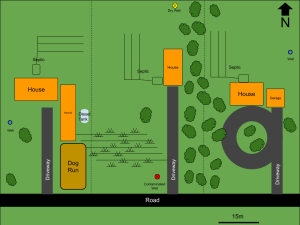
- We use this map to help train staff on how to site well locations in real settings. There are natural and man made sources of contamination, natural and man made hazards, and no obviously ideal location for a new well for the home in the middle.
Moving Forward
If you are happy with the proposed site and the well type, we stake the spot on the ground, add you to the schedule, and bring out the rig at the next opportunity.
While the actual construction process involves several moving parts, the basic timeline looks like this:
- Construction: The well is drilled or dug.
- Testing: The well is pumped to measure water quantity and tested for safety.
- Hookup: The pump is dropped into the well and the horizontal waterline is hooked up to the house.
- Treatment: Filtration and water treatment systems are installed or adapted to ensure your water is perfectly safe and clean to drink.
Ready to figure out what lies beneath your property? Give us a call (807-707-7000), and let’s start looking at the data together.